
Does Earth Currently Have a Mini Moon? The 2026 Answer
As of September 23, 2026, Earth has one permanent natural moon and no known asteroid currently captured as a traditional mini-moon. The well-known asteroid 2024 PT5 left Earth’s temporary gravitational hold in November 2024.

Earth does have a long-term companion called 2025 PN7, though astronomers classify it as a quasi-satellite. It shares Earth’s path around the Sun and remains associated with our planet for decades, while its orbit stays centered on the Sun.
The Current Status of Earth’s Temporary Companions
Earth currently has no confirmed temporary captured mini-moon, while asteroid 2025 PN7 remains a quasi-satellite companion. The distinction comes from the object’s orbit and its relationship with Earth’s gravity.
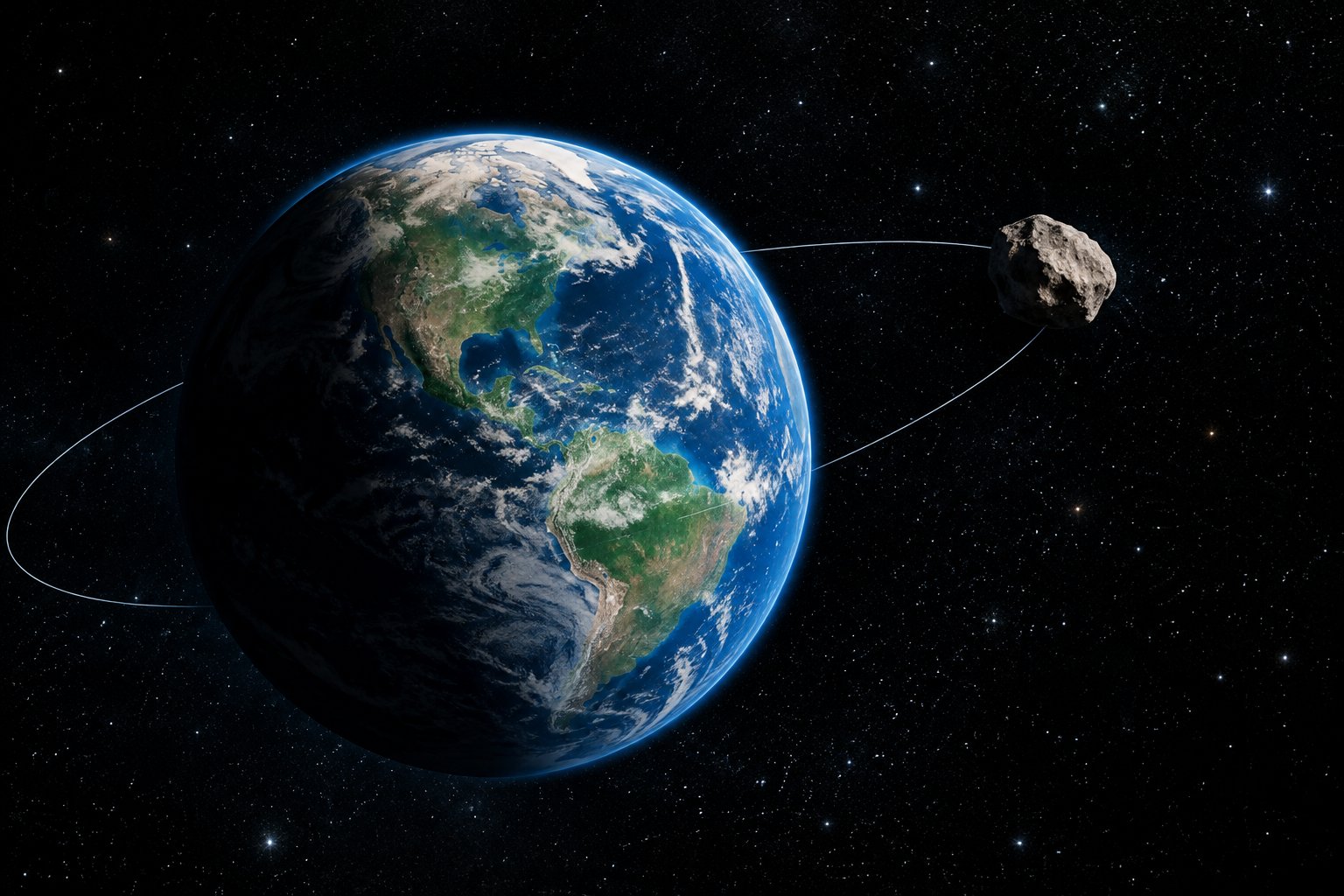
Why 2024 PT5 Is No Longer Captured by Earth
Asteroid 2024 PT5 became a temporary satellite from September 29 to November 25, 2024. During that interval, Earth’s gravity gave the near-Earth object negative geocentric energy, which means the object was bound to Earth for a short time.
Its event was classified as a temporary captured flyby. 2024 PT5 did not complete a full orbit around Earth before solar and planetary forces helped return it to a path around the Sun. Calculations using data associated with the Jet Propulsion Laboratory track its later movement away from Earth, with a future return to the planet’s neighborhood expected in the mid-2050s.
What Astronomers Mean by “Currently”
“Currently” needs a precise time frame because temporary captures come and go. A mini-moon qualifies during the period when Earth holds it in a bound orbit or captured trajectory.
As of September 2026, 2024 PT5 is no longer captured. 2025 PN7 is nearby in an orbital sense, yet it is a quasi-satellite. NASA tracks both kinds of near-Earth objects, while observatories continue searching for smaller bodies that are difficult to detect.
What Makes an Object a Mini-Moon?
A mini-moon is a small asteroid or comet that Earth temporarily captures through gravity. It becomes a satellite for a limited time before returning to a solar orbit or leaving Earth’s neighborhood.
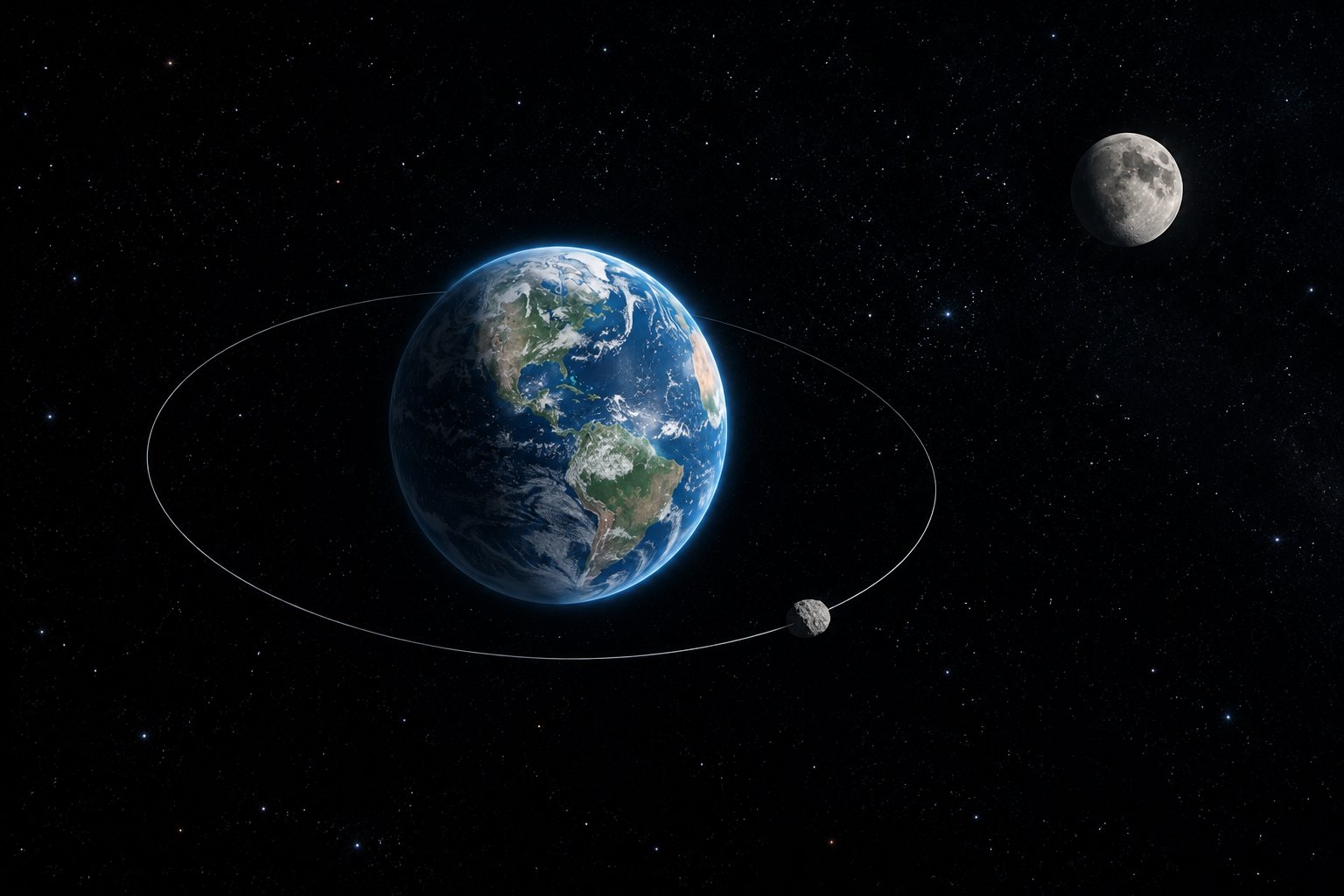
Temporary Capture vs. a Normal Asteroid Flyby
A normal asteroid flyby passes through Earth’s neighborhood while remaining on a solar orbit. Its path may bend under Earth’s gravity, yet the object remains free to continue around the Sun.
A temporary capture occurs when the object’s motion relative to Earth becomes gravitationally bound for a time. The capture can last hours, weeks, months, or years, depending on the asteroid’s speed and the pull of the Sun, Earth, Moon, and other planets.
Temporarily Captured Orbiters vs. Flybys
Astronomers use two main labels:
- A temporarily captured orbiter completes at least one full orbit around Earth.
- A temporarily captured flyby becomes bound to Earth but leaves before completing one full revolution.
2006 RH120 and 2020 CD3 were temporarily captured orbiters. 2024 PT5 joined 1991 VG and 2022 NX1 as a temporarily captured flyby.
Why a Mini-Moon Is Not a Second Moon
Earth’s Moon is a large, permanent natural satellite with a stable orbit around our planet. A mini-moon is a small space rock held by Earth for a short period.
The word “moon” describes the orbital relationship, while “mini” signals the object’s small size and brief stay. A mini-moon does not replace the Moon or create a permanent second lunar system.
How 2024 PT5 Became a Brief Visitor
Asteroid 2024 PT5 followed an Earth-like solar orbit that allowed Earth’s gravity to capture it for about 57 days. Its low relative speed and close approach created the conditions for a rare temporary satellite event.
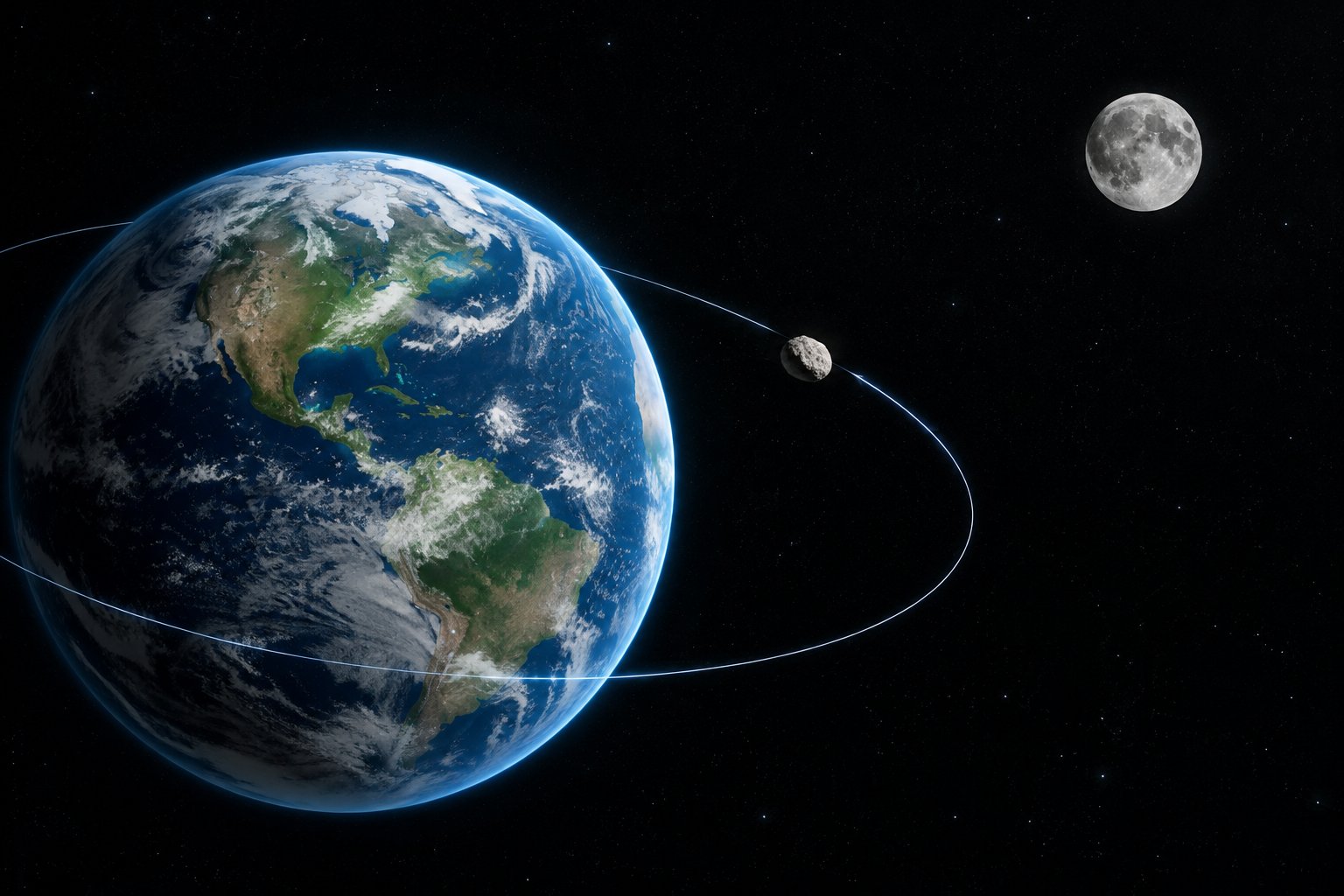
Its 2024 Capture Window
The Asteroid Terrestrial-impact Last Alert System, or ATLAS, discovered 2024 PT5 on August 7, 2024. Its absolute magnitude suggested a body roughly 10 meters across, although brightness-based size estimates depend on the asteroid’s surface reflectivity.
Orbital calculations placed its capture window from September 29 through November 25, 2024. The asteroid stayed close enough and moved slowly enough relative to Earth for the planet’s gravity to alter its path.
The Arjuna Asteroid Belt Connection
2024 PT5 belongs to the group often called the Arjuna asteroid belt. Arjunas are near-Earth asteroids with orbits that resemble Earth’s path around the Sun.
Because these asteroids travel at similar solar distances and speeds, Earth encounters them under conditions that support temporary capture. 2022 NX1 is another mini-moon linked to this population.
Why It Did Not Complete a Full Orbit
The Sun still controlled most of 2024 PT5’s long-term motion. Earth’s gravity captured the asteroid for a short interval, while the combined gravitational pulls of the Sun, Moon, and planets continued shaping its path.
That balance sent 2024 PT5 away before it completed a full circuit around Earth. Astronomers therefore classify it as a temporarily captured flyby, not a temporarily captured orbiter.
Quasi-Satellites Are Different From Captured Mini-Moons
A quasi-satellite shares Earth’s orbit around the Sun, while a captured mini-moon temporarily orbits Earth. The two objects can look similar in diagrams that use Earth-centered viewpoints, yet their gravitational paths are different.
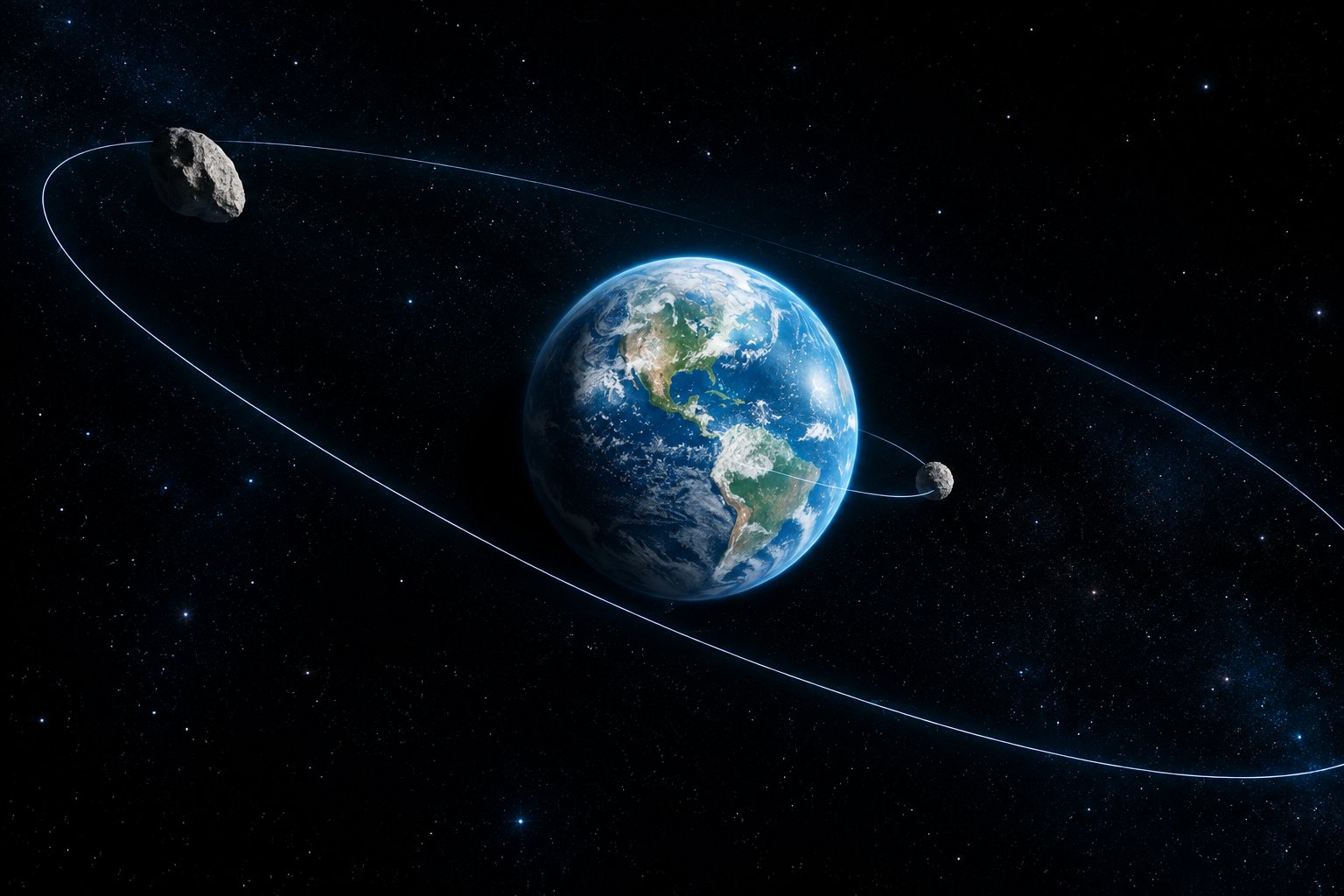
How a Quasi-Moon Shares Earth’s Orbit
A quasi-satellite travels around the Sun on an orbit close to Earth’s own orbit. From a frame that moves with Earth, the asteroid appears to loop around our planet.
Earth’s gravity influences the object, yet the asteroid remains primarily a solar-orbiting body. It can move ahead of Earth, trail behind it, and return to a nearby position over repeated trips around the Sun.
Kamoʻoalewa and Other Long-Term Companions
Kamoʻoalewa, also known as 2016 HO3, is one of Earth’s best-known quasi-satellites. It has remained near Earth’s orbital path for a long time and may be a fragment blasted from the Moon during an ancient impact.
Pan-STARRS in Hawaii discovered Kamoʻoalewa. China’s Tianwen-2 mission is examining the object and is planned to collect samples, giving scientists a closer look at a small companion in Earth’s neighborhood.
Why 2025 PN7 Should Not Be Called a True Moon
2025 PN7 is a quasi-satellite discovered through observations from Pan-STARRS in Hawaii. Earlier data showed that it has followed its current quasi-satellite path for roughly 60 years and may remain in that configuration for several more decades.
Calling it a second Moon suggests that it circles Earth as a natural satellite. Its orbit follows the Sun with Earth, so quasi-moon or quasi-satellite is the accurate label.
Past and Future Discoveries in Earth’s Neighborhood
Earth has captured small natural satellites before, and improved telescope surveys should reveal more of these short-lived companions. The known examples show that temporary captures range from objects a few meters wide to bodies around 10 meters across.
Notable Cases: 2006 RH120 and 2020 CD3
2006 RH120 stayed gravitationally bound to Earth from July 2006 to July 2007. It measured roughly 2 to 7 meters across and completed at least one orbit, making it a temporarily captured orbiter.
2020 CD3 remained with Earth for more than two years before leaving in 2020. Its estimated diameter was about 1 to 2 meters. Both objects were natural asteroids, although early observations of small companions can raise questions about possible spacecraft or rocket debris.
Why Tiny Captures Are Hard to Spot
Small mini-moons reflect little sunlight and move quickly across the sky when they pass close enough to become bright. A telescope may record a short streak instead of a clear point of light, which complicates automated searches.
Their temporary nature adds another challenge. A survey might observe the object on only a few nights before clouds, daylight, distance, or rapid motion removes it from view. Once astronomers calculate its orbit, follow-up observations become easier.
How New Sky Surveys Will Find More
The Vera C. Rubin Observatory’s Legacy Survey of Space and Time, known as LSST, is designed to scan the sky repeatedly over many years. Its wide coverage and frequent observations should improve the search for near-Earth objects, including faint temporary companions.
Future space missions and spacecraft could also visit mini-moons because their Earth-like orbits may require less fuel to reach. Each discovery gives astronomers another chance to study how asteroids move through the Earth-Moon system.