
Does Mary Have a Child? Exploring the Joys of Parenthood
Many people wonder about the life of Mary, the mother of Jesus, especially when it comes to her children. The answer to whether Mary had other children is yes; she had several sons, including Joseph, James, Jude, and Simon. This detail may surprise you, as traditional beliefs often portray her as a perpetual virgin.

Throughout the scripture, you can find references to Mary’s other children, leading to different interpretations among various Christian denominations.
Exploring these passages can give you a deeper understanding of Mary’s role and her family dynamics.
As you dive into this topic, consider how Mary’s role as a mother shapes the narrative in the Bible and influences beliefs today. Understanding her story might change how you view the relationships and responsibilities of mothers in faith.
Mary’s Life and the Doctrine of Perpetual Virginity

Mary’s life is deeply intertwined with the doctrine of her perpetual virginity. This belief holds that she remained a virgin before, during, and after the birth of Jesus.
Understanding this doctrine requires exploration of scripture and the differing views from both Catholic and Protestant traditions.
Scriptural References to Mary’s Virginity
The Bible offers several key references that support Mary’s virginity. In the Gospel of Matthew, the angel announces to Joseph that Mary will give birth to Jesus, stating she is “found with child of the Holy Spirit” (Matthew 1:18).
Moreover, the prophecy in Isaiah 7:14 speaks of a virgin who will conceive and bear a son. Here, the Hebrew word used suggests a young woman, but the implication aligns with the belief in Mary’s perpetual virginity.
In the early Church, especially through writings like the Protoevangelium, her lifelong commitment to virginity is emphasized. This idea underscores her unique role in salvation history.
Catholic and Protestant Perspectives
The Catholic Church firmly upholds the doctrine of Mary’s perpetual virginity as essential. This belief demonstrates her purity and complete devotion to God. It is considered a significant aspect of her identity as the Mother of Jesus.
In contrast, Protestant reformers, including Martin Luther, had varied views. While some recognized Mary’s virginity at Christ’s birth, they questioned the notion of her remaining a virgin afterward.
This debate stems from differing interpretations of scripture and the emphasis on personal faith.
The discussion about Mary’s virginity continues to create dialogue between denominations. Acknowledging these perspectives can enrich your understanding of Mary in Christianity.
The Question of Mary’s Children
When exploring whether Mary had other children, it’s important to look at specific passages in Scripture and the varying interpretations that have arisen. This will help clarify the relationships mentioned in the Bible.
The Brothers and Sisters of Jesus in Scripture
In the Bible, several passages mention Jesus’ brothers and sisters. For example, Matthew 13:55-56 names four brothers: James, Joseph, Simon, and Jude. Additionally, it mentions sisters without naming them.
These references lead many to believe that Mary had other children after Jesus. However, terms like “brothers” and “sisters” can also imply a broader family relationship, such as cousins or close relatives.
People often debate whether these siblings were Mary’s biological children or from another family dynamic. Some traditions assert that Mary remained a virgin, viewing Jesus’ siblings as either Joseph’s children from a prior marriage or simply cousins.
Different Interpretations of ‘Brethren’ in the Bible
The term “brethren” creates confusion for many readers. While it typically denotes close family, some biblical scholars suggest it could refer to more distant relatives or friends.
For example, the Apostle Paul uses “brethren” in a way that might not always mean literal siblings. This opens the door for the idea that the references to Jesus’ brothers and sisters could be interpreted differently.
It’s essential to consider these interpretations when reading passages about Jesus’ family. Knowing the context helps you understand the relationships mentioned. Whether they were literal brothers, cousins, or other relatives, this topic continues to be significant in theological discussions.
Historical and Theological Context
Understanding the views on whether Mary had other children involves looking at early church teachings and the language used in biblical texts. Both areas shed light on varying interpretations surrounding Mary’s family.
Views of Early Church Fathers
Early Church Fathers had differing opinions about Mary’s motherhood. Some, like St. Jerome, upheld the belief in her perpetual virginity. They emphasized that Mary had no other children besides Jesus. This view became prominent in Catholic doctrine.
Others, such as Tertullian, suggested that Jesus had siblings. They interpreted passages mentioning “brethren,” likely referring to James, Joseph, Simon, and Judas. This led to debates about whether these figures were Jesus’ actual brothers or cousins.
Key Figures:
- St. Jerome: Advocated for Mary’s perpetual virginity.
- Tertullian: Engaged with the idea of Jesus having brothers.
Linguistic Perspectives on Family Terms
In biblical texts, terms like “brother” and “sister” can be complex. In Aramaic, the language spoken during Jesus’ time, these words often referred to close relatives, not just siblings.
This raises questions about the interpretation of family dynamics.
For instance, in Matthew 13:55-56, Mary’s children are mentioned. However, the original meaning might imply a broader definition of family. This linguistic nuance can lead you to understand that these “brethren” could be cousins rather than direct siblings.
Important Notes:
- Aramaic Terms: Family terms may have different meanings.
- Matthew’s Mention: Contextual understanding is crucial.
Joseph’s Role in the Holy Family
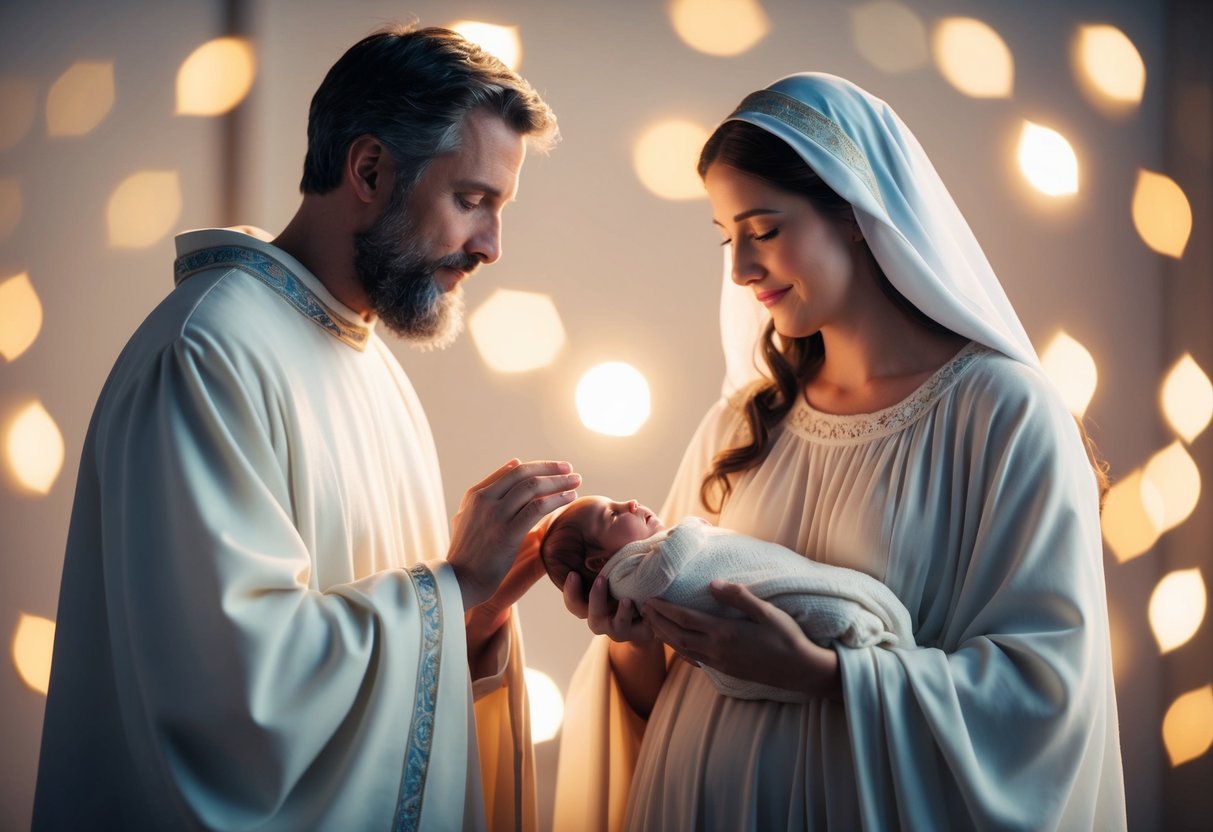
Joseph plays a vital role in the Holy Family as the protector and provider. His actions not only support Mary and the infant Jesus but also shape their early lives and experiences.
Joseph and Mary’s Relationship
Joseph and Mary’s relationship is central to the story of Jesus. When Mary was found to be with child, Joseph showed great compassion.
He initially planned to dismiss her quietly to protect her from public shame. However, after an angel appeared to him in a dream, he accepted Mary and her miraculous pregnancy. He took on the role of husband and guardian with faith.
Joseph provided for Mary and Jesus, working as a carpenter in Nazareth. His commitment to his family is clear in the care he showed.
Through journeys, including their trip to Bethlehem for the birth of Jesus, Joseph remained steadfast. He ensured they had safety and stability. His support was crucial for Mary during this transformative time.
Children of Joseph from Previous Accounts
While the Bible primarily focuses on Joseph’s role as the earthly father of Jesus, some traditions suggest he may have had children from a previous marriage. These children, often referred to as Jesus’ “brothers and sisters,” are mentioned in the Gospels.
This belief has led to various interpretations regarding family dynamics in the Holy Family. Some traditions hold that these siblings were Joseph’s biological children, while others view them as cousins or close relatives.
Regardless, Joseph’s primary role was to raise Jesus, his firstborn son. This responsibility placed Joseph in a significant position in the narrative of Jesus’ life. He guided and protected not only Mary but also the child destined to change the world.