
How Many Invitations for 150 Guests? Tips for Planning Your Event
When planning your wedding, figuring out how many invitations to send can feel overwhelming. If you’re expecting around 150 guests, you need to understand how many invitations you actually need. A good rule of thumb is to send out about 150 invitations for your 150 guests, but remember that some invitees may not be able to attend.

Estimating your guest list accurately can help you avoid overordering. Consider that typically, about 25-40 percent of guests might decline the invitation. This means that if you send out the expected number of invites, you can confidently plan for around 90 to 120 attendees at your big day.
Make sure to double-check your guest list before placing your order. While it’s tempting to invite everyone, a well-thought-out list can keep your plans organized and under budget.
Determining Your Guest List

Creating your wedding guest list can feel like a big task, but breaking it down helps. Start by identifying your closest friends and family.
Next, categorize your groups to make sure you cover everyone important to you without going overboard on numbers.
Identifying Your Circle
Begin with your immediate family. This usually includes parents, siblings, and their families. For each family unit, consider how many invitations you will need. If parents or siblings are couples, you typically need one invitation per couple.
Next, move on to your close friends. Think about those who have supported you through life’s highs and lows. If they are single, plan for one invitation per person. If they are dating, consider sending them a plus one.
Finally, don’t forget to think about colleagues or acquaintances who may be significant in your life but may not fit into the close circle.
Categorizing Groups
Once you have your circle, start categorizing. You can create groups based on relationship closeness.
For example, family could be one group, close friends another, and colleagues a third.
Within each group, list the people you want to invite. Keep track of who might bring a plus one. Typically, around 30% of single guests may bring their dates. It’s smart to factor this in for your total guest count.
You can also use a simple table or list to organize your thoughts:
| Group | People | Invitations Needed |
|---|---|---|
| Immediate Family | 10 (5 couples) | 5 |
| Close Friends | 15 (5 singles, 5 couples) | 10 |
| Colleagues | 5 (2 singles) | 5 |
This method helps ensure you don’t miss anyone while keeping your invitations manageable.
Deciding on Invitation Quantity

When planning to invite 150 guests, it’s important to consider how many invitations you will actually need to send. This includes calculating invitations per household and accounting for extra ones for addressing errors and other potential needs.
Calculating Invitations per Household
To figure out how many invitations to order, think about your guest list in terms of household units. If you have families attending, you won’t need an invitation for each individual.
For example, if you invite a couple with two kids, that counts as one invitation, not four.
Here’s a quick breakdown:
| Number of Guests | Estimated Invitations |
|---|---|
| 50 Guests | 30 Invitations |
| 100 Guests | 60 Invitations |
| 150 Guests | 90 Invitations |
This should help you understand how many invitations to prepare based on your guest structure. Adjust as needed based on your specific guest list.
Accounts for Extras
It’s a good idea to order extra invitations. Mistakes happen, and you may need to readdress invitations due to errors or late additions to your guest list.
Ordering 10-15% more invitations can prevent stress later. For example, if you plan for 90 invitations, consider ordering about 100. This will allow for any mistakes or last-minute changes without a rush to reorder.
Extra invitations can also be helpful for keepsakes or for inviting someone later that you hadn’t initially included. Think of these extra copies as a safety net for your wedding planning.
Wedding Invitations and Budgeting

When planning your wedding, managing your budget is essential. Wedding invitations play a key role in your overall costs, and knowing how to allocate funds for them can help you stay on track.
Costs Associated with Wedding Invites
The cost of wedding invitations varies greatly depending on the design, materials, and quantity you choose. On average, you can expect to spend between $1 to $10 per invitation.
Consider these factors:
- Invitation Suites: Includes the main invite, RSVP card, and any additional elements like a save-the-date.
- Printing Methods: Digital printing is often less expensive than letterpress.
- Envelopes and Accents: Custom envelopes or wax seals can add to costs.
If you’re inviting 150 guests, plan for around $256 to $312 for your invitations based on typical prices.
Budget Allocation
Allocating your budget effectively is crucial. Start by determining how much of your total wedding budget can go toward invitations.
A common suggestion is to allocate around 3-5% of your total wedding budget for invitations.
For example, if your wedding budget is $20,000, you might spend between $600 to $1,000 on invitations.
Next, assess how many invitations you actually need. It’s often recommended to order 10-20% extra to cover last-minute additions or mistakes. Keeping track of those numbers helps you manage your overall wedding costs effectively.
Timeline and Communication
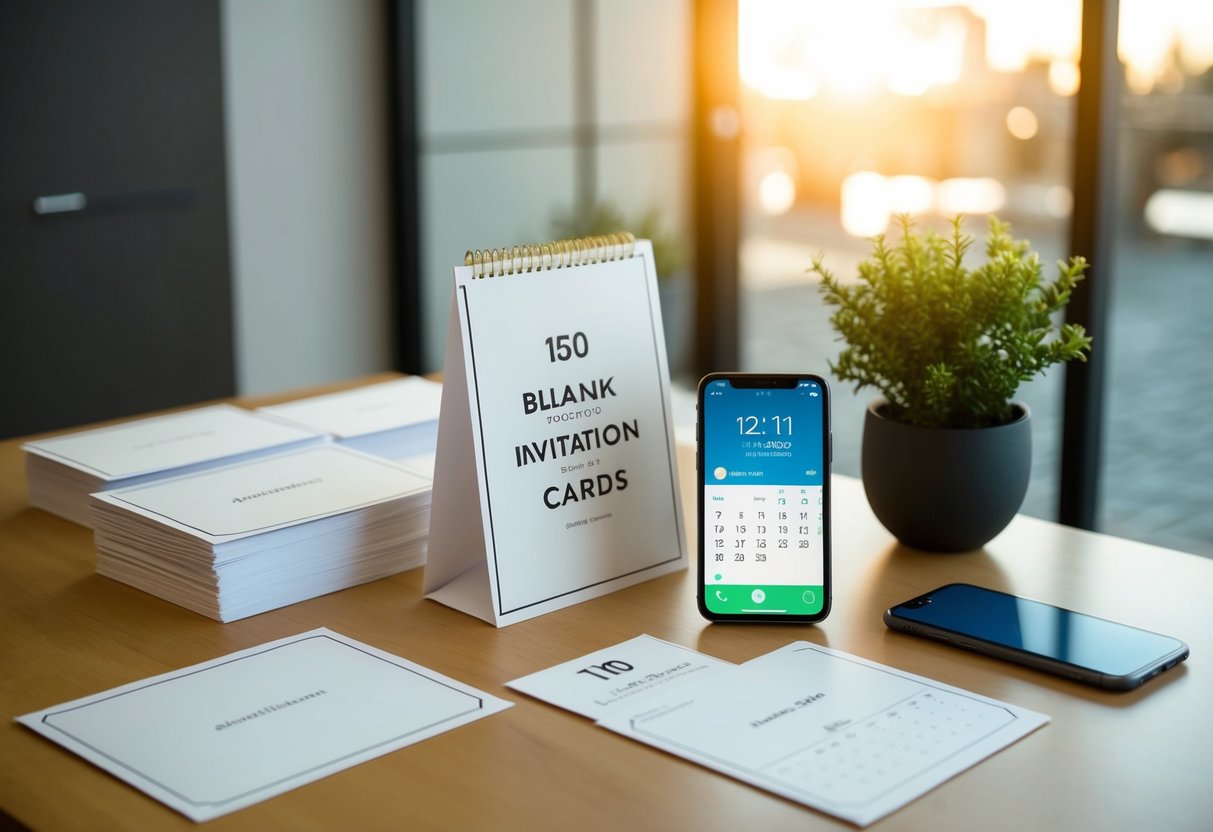
Effective communication and a clear timeline are key to managing your invitations for 150 guests. This ensures everyone stays informed and helps you keep track of responses, which can impact your planning process, especially catering.
Sending Save-the-Dates
Sending save-the-dates is a friendly way to give your guests a heads-up about your wedding.
Ideally, you should send these out about 6-8 months before the big day. This gives everyone ample time to arrange their schedules.
For a guest list of 150, it’s smart to send save-the-dates to everyone you plan to invite.
You might consider digital options to save time and money. If you are using printed cards, make sure they match your wedding theme.
Include essential details such as the date and location, even if it’s just a city. This helps guests begin planning their travel and accommodations early.
Tracking RSVPs
You must track RSVPs for your wedding planning. Aim to request responses 4-6 weeks before the wedding date. This timeline allows you to finalize counts for catering and seating arrangements.
You can use digital tools or traditional methods like response cards to manage RSVPs more effectively. Collecting RSVPs through an online site can help streamline this process.
Keep a list where you note who has responded, including their meal choices if applicable. A clearer picture of who will attend helps make your big day smoother. If you notice several guests haven’t responded as the deadline approaches, you might need to reach out personally.