
Wedding Officiant Script Examples for Every Ceremony Style
A well-written wedding officiant script gives the ceremony a clear shape while leaving room for the couple’s personality. From the welcome and opening words to the declaration of intent, vows, ring exchange, and pronouncement, each part should sound natural when spoken aloud.
The strongest ceremony scripts combine essential legal wording with language that reflects the couple’s relationship, values, and sense of humor. We recommend reading every passage aloud, marking pauses, and confirming the final wording with the couple and officiant before the wedding day. Use these wedding officiant script examples as a foundation, then shape each line around the people getting married.
Short and Simple Ceremony Script Examples
Short ceremony scripts work best when every sentence has a purpose and the transitions are easy to deliver. These examples provide a flexible wedding ceremony template for a civil celebration, modern wedding ceremony, or friend-led ceremony.
A 5-Minute Civil Ceremony Script
“Welcome, everyone. We are gathered today to celebrate the marriage of [Name] and [Name].
[Name] and [Name], you have chosen each other as life partners and now make that commitment publicly.
Do you, [Name], take [Name] to be your spouse, to share your life with love, respect, and care?”
“I do.”
“Do you, [Name], take [Name] to be your spouse, to share your life with love, respect, and care?”
“I do.”
“Please repeat after me: I take you to be my spouse. I promise to stand beside you, honor you, and share my life with you.”
Each partner repeats the pledge. After the ring exchange, the officiant says:
“By the authority granted to me, I pronounce you married. You may kiss.”
“Friends and family, please celebrate [Name] and [Name] as they begin their married life together.”
A Short and Sweet Modern Ceremony Script
“Welcome, loved ones. Your presence gives this moment meaning as we celebrate [Name] and [Name].
Their relationship has grown through ordinary days, shared plans, and the choice to keep showing up for each other. Today, they promise to continue that work with joy and intention.
[Name] and [Name], do you promise to love each other, support each other’s dreams, and meet life’s changes as partners?”
“We do.”
“Please exchange your vows and rings as symbols of the promises you are making.”
After the vows and rings:
“May your marriage be filled with kindness, laughter, and the freedom to become more fully yourselves. By the authority entrusted to me, I pronounce you married. You may kiss.”
A Simple Friend-Officiant Script
“Welcome, everyone. I’m grateful to stand with [Name] and [Name] as they begin this new chapter.
I have seen the care, laughter, and trust that brought them to this day. Their marriage is built on a friendship that gives them strength and a love that keeps growing.
[Name] and [Name], please look at each other and remember this feeling. Do you choose one another as spouses and promise to support, respect, and love each other through the years ahead?”
“We do.”
“Please share your vows and exchange your rings.”
After the exchange:
“May you keep finding reasons to laugh, listen, and choose each other. By the authority granted to me, I pronounce you married. You may kiss.”
The Essential Words in a Wedding Ceremony
A complete wedding ceremony script moves from welcome and gathering words into the charge, declaration of intent, vows, rings, pronouncement, kiss, and recessional. Each element can use traditional language, modern wording, or personal phrasing while preserving a smooth ceremony order.
Welcome and Gathering Words
The welcome sets the emotional tone and acknowledges the guests’ role in the marriage ceremony.
“Welcome, family and friends. We are gathered here today to celebrate the love and commitment of [Name] and [Name]. Thank you for being present as they promise to build a life together.”
For a warmer opening, we might add:
“Each person here has shared part of their journey. Your love and support have helped bring them to this moment, and your presence surrounds them as they begin married life.”
The Charge to the Couple
The charge to the couple invites them to treat marriage as an ongoing practice of care, honesty, and partnership.
“Marriage asks you to listen with patience, speak with kindness, and make space for each other’s hopes. Hold on to the friendship that brought you here, and meet difficult days with honesty and compassion.”
Declaration of Intent Wording
The declaration of intent creates a direct opportunity for each partner to affirm the marriage.
“[Name], do you take [Name] to be your spouse, promising to love, honor, and support them for all the days of your life?”
“I do.”
Repeat the question for the other partner. Couples should confirm any required wording with the person conducting the ceremony and the appropriate local authority.
Promise and Vow Exchange Examples
Repeat-after-me vows give the officiant control over pace:
“I take you, [Name], to be my spouse. I promise to love you, respect you, and stand beside you through every season of our life together.”
Traditional vows offer familiar language:
“I take you to be my lawfully wedded spouse. I promise to have and to hold you, for better or for worse, for richer or for poorer, in sickness and in health, for as long as we both shall live.”
Personal vows bring the couple’s voice into the ceremony:
“[Name], I choose you as my partner and my closest friend. I promise to celebrate your joys, support you through challenges, and keep building a home filled with patience, laughter, and love.”
Ring Exchange Wording
The ring exchange connects a physical symbol with the promises already spoken.
“Please place the ring on [Name]’s finger and repeat after me: I give you this ring as a symbol of my love and commitment. With it, I join my life to yours.”
A shorter version is:
“May this ring remind you of the promise we share today. I give it to you with love.”
Pronouncement, Kiss, and Recessional
The pronouncement completes the legal and ceremonial declaration.
“[Name] and [Name], you have made your promises, exchanged rings, and declared your commitment before the people who love you. By the authority granted to me, I pronounce you married. You may kiss.”
After the kiss:
“Please join us in celebrating the newly married couple as they begin their recessional.”
Scripts by Ceremony Style and Tradition
The ceremony’s tradition determines which prayers, readings, rituals, and declarations belong in the script. A non-religious wedding ceremony can focus on shared values, while Christian, Catholic, interfaith, or Jewish ceremonies can incorporate faith-specific language with the couple’s approval.
Non-Religious Wedding Ceremony Example
“Welcome, family and friends. We are here to celebrate the love [Name] and [Name] have built and the future they are choosing together.
Marriage is a promise to share responsibility, make room for growth, and return to one another with care. [Name] and [Name], do you promise to support each other’s dreams, communicate with honesty, and create a life shaped by love and respect?”
“We do.”
“Please share the vows you have written for each other.”
After the rings:
“These rings represent the promises spoken today and the life you will continue creating together. By the authority granted to me, I pronounce you married.”
Traditional and Christian Wedding Ceremony Example
“Dearly beloved, we are gathered in the presence of God and these witnesses to join [Name] and [Name] in the covenant of marriage.
Marriage calls for faithful love, patience, forgiveness, and mutual service. Will you, [Name], receive [Name] as your spouse and promise to love, honor, and cherish them in joy and difficulty, for as long as you both shall live?”
“I will.”
A Christian ceremony might include a prayer or invocation:
“May God bless this marriage with wisdom, peace, and enduring love. May [Name] and [Name] support one another and grow together in faith.”
A Catholic wedding ceremony may follow a prescribed liturgy and include communion. Couples should work with their priest on the exact marriage ceremony script and required readings.
Interfaith and Jewish Ceremony Elements
Interfaith ceremonies succeed when each tradition receives clear, respectful space in the ceremony order. The couple might include readings from both faiths, a shared prayer, or language about a covenant of marriage.
Jewish wedding elements can include the ketubah signing, seven blessings, ring exchange, and breaking the glass. A sample transition might say:
“Today, these traditions meet in a marriage shaped by mutual respect. May the blessings spoken here surround [Name] and [Name] with joy, compassion, and peace.”
Before the breaking of the glass:
“The glass reminds us that life contains fragility as well as celebration. May [Name] and [Name] bring care to every part of their shared life.”
Funny but Meaningful Ceremony Wording
Humor works best when it reveals affection and respects everyone present.
“Marriage is a lifelong partnership in love, laundry, calendar negotiations, and deciding what to order for dinner. [Name] and [Name] have already demonstrated impressive teamwork, especially when one of them says, ‘I’m fine,’ and the other knows to ask a follow-up question.”
Follow the joke with a sincere charge:
“Keep laughing together, especially on difficult days. Keep listening when the answer is complicated. Keep choosing one another with the same affection that brought you to this place.”
Personalizing the Script Without Losing the Flow
A personalized script stays easy to follow when every story, reading, ritual, and legal line has a defined place in the wedding ceremony order. We recommend keeping transitions short and giving the officiant clear stage directions.
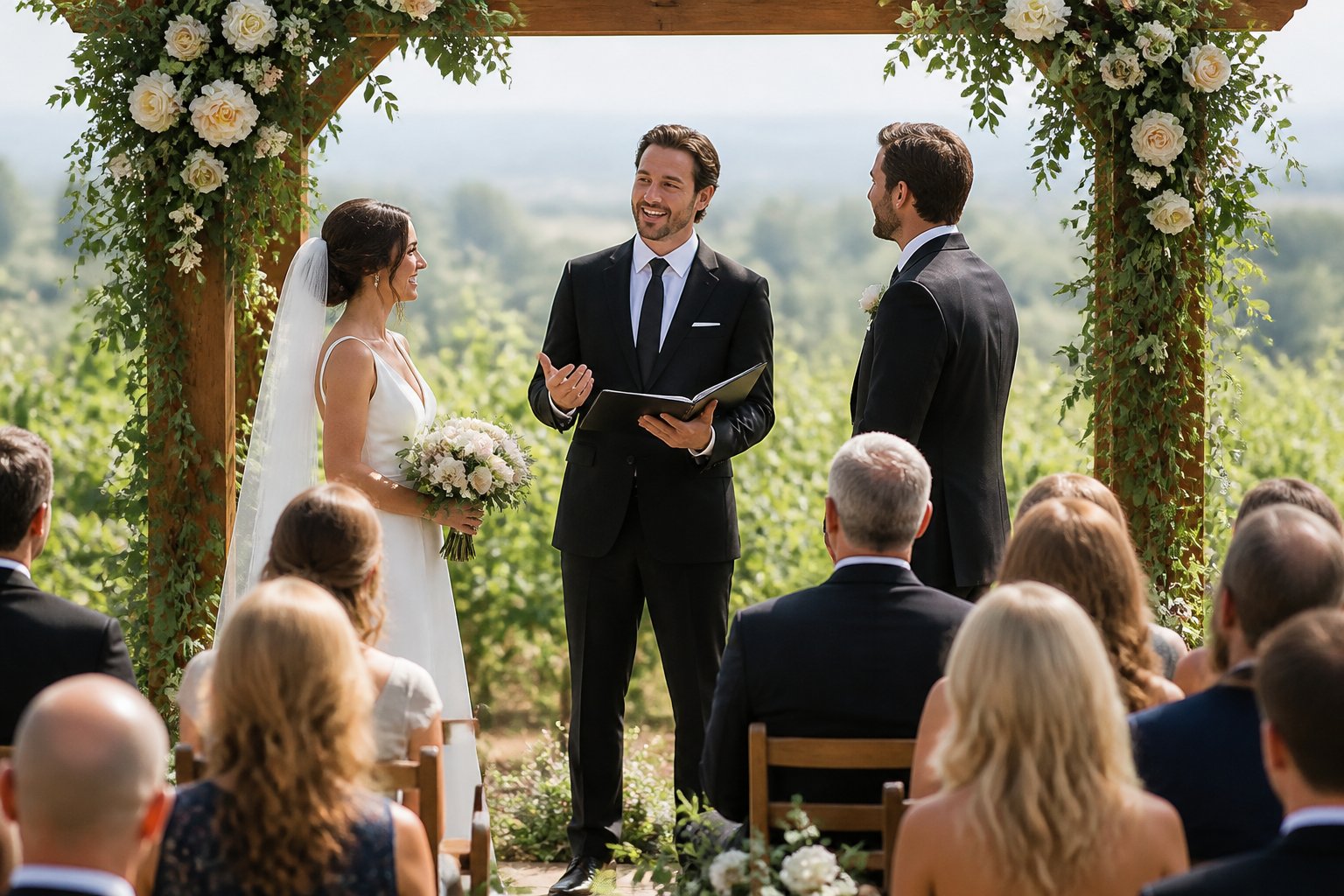
Adding the Couple’s Story and Wedding Readings
Choose one or two details that show how the couple relates to each other. A concise story about their first meeting, a shared value, or a meaningful turning point gives guests context without turning the ceremony into a biography.
Introduce wedding readings with a clear connection:
“[Reader] will now share a reading about the patience and joy that help love grow.”
Ask readers to rehearse with the microphone and confirm the pronunciation of every name.
Including a Unity Ceremony or Moment of Silence
A unity ceremony belongs after the vows or before the rings, where it can reinforce the promises already spoken. For a sand ceremony, the officiant might say:
“Each of these sands represents an individual life. As they are poured together, they symbolize the shared life [Name] and [Name] are creating.”
A moment of silence can honor absent loved ones:
“We invite everyone to pause for a moment of silence in remembrance of those whose love remains part of this day.”
Handfasting ceremony wording should explain the symbolism before the cords are placed.
Matching the Script to the Wedding Ceremony Order
Build the document around the processional, welcome, readings, vows, rings, pronouncement, and recessional. Put stage directions in brackets and use bold labels so the wedding officiant can move confidently from one moment to the next.
Print a large enough font for outdoor light, add page numbers, and leave space for last-minute notes. A timed rehearsal reveals pauses that are easy to miss when reading silently.
Reviewing Legal Details With the Officiant
Legal wording and filing requirements differ by state, county, and ceremony type. The couple, wedding officiant, or professional celebrant should confirm who may solemnize the marriage, which declaration is required, and how the marriage license must be completed and returned.
A friend who wants to become a wedding officiant can review requirements through the relevant state office and organizations such as American Marriage Ministries. Treat online ordination as one step in preparation, then verify local rules directly before the wedding date.
A Ceremony Script That Sounds Like the Couple
A successful wedding ceremony script gives the officiant structure while allowing the couple’s natural voice to lead the emotional moments. We recommend pairing a familiar ceremony framework with personal vows, selected traditional vows, and language drawn from the couple’s daily life.
Read the script aloud together and remove phrases that feel stiff or out of character. Keep the legal declarations unmistakable, place personal stories where they support the ceremony’s movement, and rehearse the transitions around the vow and ring exchange.
Frequently Asked Questions
What should a wedding officiant say in a short ceremony?
A short ceremony should include a welcome, brief reflection on the couple, declaration of intent, vows, ring exchange, pronouncement, and recessional direction. A focused script can take five to ten minutes when each passage is concise.
Can a friend use a wedding officiant script?
A friend can use a wedding officiant script after confirming that they are legally authorized to perform the ceremony in the applicable jurisdiction. The friend should rehearse aloud, clarify stage directions, and coordinate the marriage license responsibilities with the couple.
What legal wording must be included in a wedding ceremony script?
Required wording varies by state and sometimes by county, so the couple should confirm it with the local clerk or authorized officiant. The script should clearly include the couple’s consent and any prescribed declaration before the pronouncement.
How do you make a non-religious wedding ceremony script personal?
Include a concise story, a meaningful reading, a shared value, or a unity ceremony that reflects the couple’s life. Personal vows can add detail while the officiant keeps the transitions and required declarations clear.
Should couples write personal vows or use traditional vows?
Couples can choose personal vows, traditional vows, repeat-after-me vows, or a combination. Traditional vows provide familiar structure, while personal vows create space for specific promises that sound like the people making them.
Where can I find free wedding officiant script examples?
Free ceremony scripts are available through officiant organizations, ceremony planning websites, and wedding planning resources. We recommend comparing several examples, selecting the structure that fits the ceremony, and checking every legal line with the authorized officiant.